


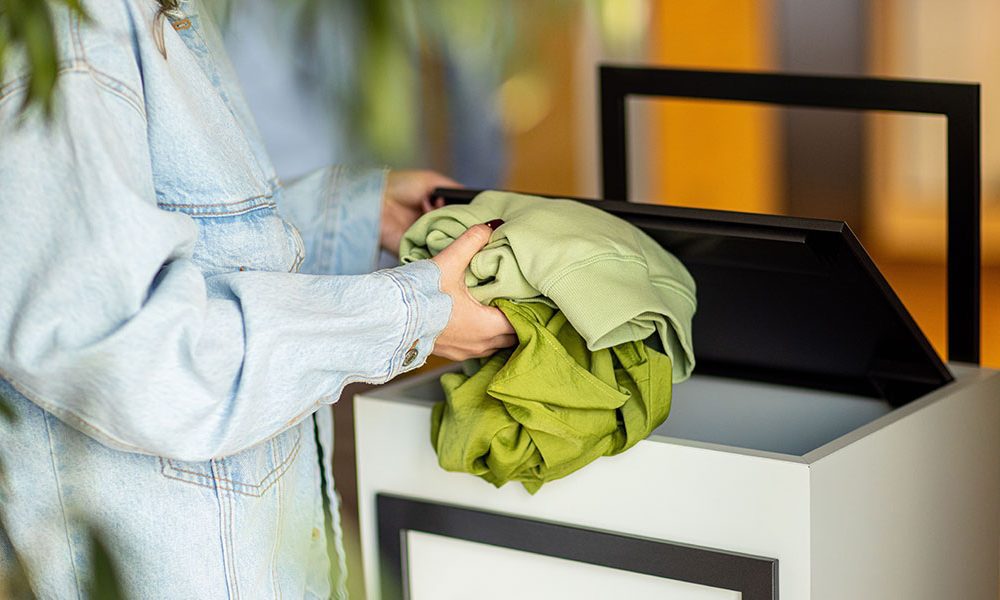
Clothing collection
The clothing collection programme is our response to the importance of closing the textile cycle and extending the life of the clothes, shoes and accessories that our customers no longer need. It is also a way to reduce textile waste while supporting social initiatives.
collected clothing in stores of all brands in Poland
of clothing sorted so far was introduced into the second circulation
We have been running a used clothing collection program since 2018. In 2023, we included all LPP stores in Poland, and in 2024 we expanded it to include stores abroad – the program currently operates in stores in Bulgaria, the Czech Republic, Lithuania, Slovakia, the United Kingdom, and North Macedonia (where it is a legal requirement).
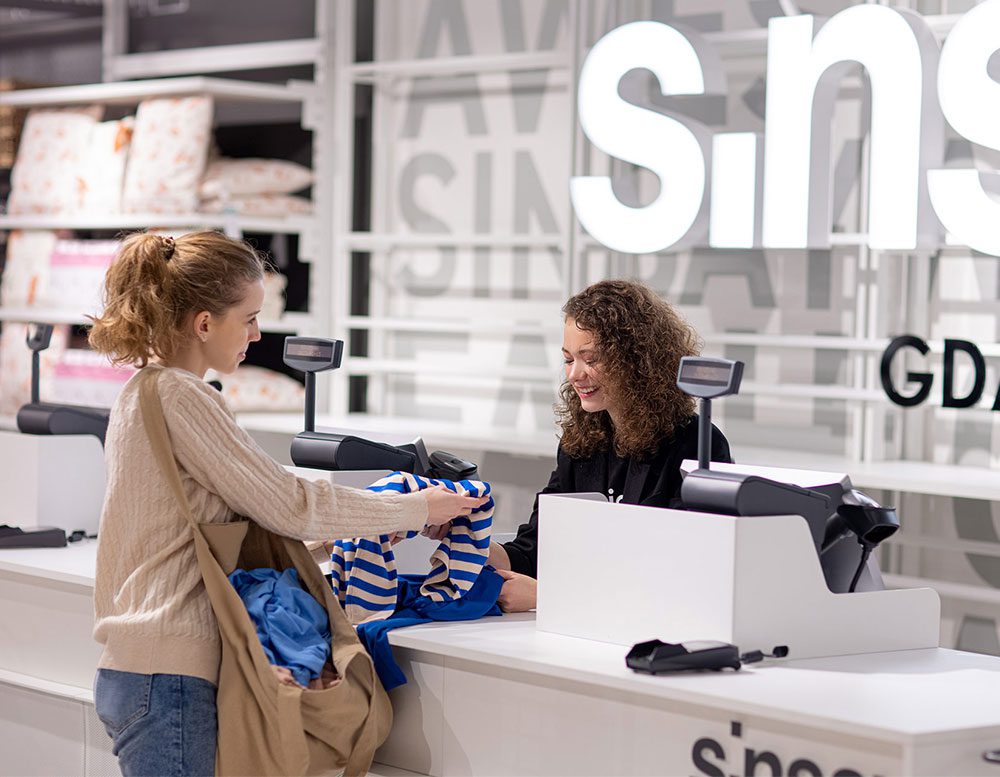
How does it work?
Used clothes, shoes and accessories can be brought to any shop of all LPP brands. Special bins for unwanted clothes are available in most stores. If the shop does not have them, you can give the packed items directly to the salesperson. The most important thing is that the donated textiles are not dirty or wet.
The donated clothing articles are sent to action partners, who then sort the items – those suitable for further use are refreshed and put into second rotation. The remaining ones are upcycled, downcycled or recycled according to the textile waste hierarchy.

Have questions? Check the FAQ.
Does the donated clothing have to be from the LPP brands?
No, you can donate textiles from any brand.
Can I donate shoes and accessories too?
Yes, we collect not only clothes but also shoes and accessories.
Can I return clothes that are not in good condition?
Clothing may show signs of wear, provided that its condition allows it to be reused. The collected textiles are first professionally sorted by type, quality, and even type of material. Clothes suitable for reuse are channelled into the second-hand market, including for sale in second-hand clothes shops. The remaining items are sent for upcycling, downcycling, recycling or conversion into alternative fuel.
What happens to the textiles donated in stores?
We send the collected clothes from the LPP shops to our partners, where they are professionally sorted. Each item is assigned to an appropriate category in order to keep it in circulation for as long as possible. Our partners operate various business models but, according to the following hierarchy, the clothes can be:
- sold in second-hand clothing stores – with some partners donating a share of the profits to charity,
- upcycled – to be used to produce higher-value items, such as home decoration,
- downcycled – to be reprocessed into lower value textiles, e.g. cleaning cloths,
- recycled – will be processed into fibres and reused in the production of textiles.
Clothing items that cannot be reused or recycled due to their very poor quality or their failure to meet hygiene and safety standards undergo a rigorous waste management process.
How do we verify where the collected clothes actually go?
The organisations we work with have substantial experience in the industry and have developed transparent verification and reporting procedures. They ensure that textiles are handled in accordance with the agreed process hierarchy.
Who are the collection partners?
We work with local organisations, so that their projects have a direct impact on the local communities. We select them based on their experience, good practices in collecting used clothing, and level of transparency.
Until September 2025, clothing collected in Poland through the St. Brother Albert Aid Society was distributed to people in need. However, as collection volumes increased, the scale of the textiles being distributed exceeded the partner’s operational capacity and current needs. To ensure the continuity of the process and the effective and transparent management of the collected clothing, the stream was redirected to Wtórpol. Wtórpol channels textiles suitable for wear into the second-hand market (through sale in second-hand clothing shops), whilst the remaining fractions are managed in accordance with the EU hierarchy for handling collected textiles. In Slovakia, the collection is operated by Ekocharita, in Lithuania by Refabrik, in Bulgaria by TexCycle, in the Czech Republic by Ubrania do Oddania, in North Macedonia by ECO-TEXT Group, and in the United Kingdom by Yellow Octopus Group.
Does LPP profit from the collection?
The proceeds from the resale of clothing are used by the collection partners to fund their operations related to sorting, putting textiles back into second-hand circulation, and recovering materials.
Towards circular fashion
Collecting used clothing is the first step towards circular fashion, which allows us to keep clothing, footwear and accessories in circulation. Despite efforts to prolong the lifespan of textiles, eventually each product will lose its functionality. We aim to ensure that, even when it happens, they do not become waste, but are put back into circulation through recycling. Currently, only 1% of used textiles are fully recycled.
Recycling technologies are not yet sufficiently developed to cover market demand. This is why it is so important for us to fund innovation in this area and to expand our in-store collection programme. We have allocated 2 million zlotys to the development of a new clothing recycling technology in Poland.
Social aspect
From 2022 to 2025, we cooperated with the St. Brother Albert Aid Society as part of the “Sortownia” project, carried out at the Social Integration Centre in Gdynia. The initiative made it possible to combine the management of clothing collected in Poland with the social and professional activation of the organisation’s beneficiaries by creating jobs related to textile sorting.
However, as the programme developed and the volume of donated clothing increased, the scale of the process began to exceed the operational capacity of the existing model. To ensure continuity, efficiency and transparency in the management of collected garments, Wtórpol became the partner responsible for handling the collection process.
Wtórpol is responsible for the professional sorting of clothing and directing it to the appropriate management streams. For every kilogram of clothing collected in LPP stores in Poland, an amount of PLN 0.50 is charged. These funds will be allocated to maintaining the collection system and to a charitable cause selected by LPP.